It`s been 3 weeks since that day and I finally cook again. By cook I mean making our food, taking pictures, and now writing about it. A week after the big quake, I did cook everyday. In fact, more often than I usually did on normal days because there were only few restaurants/shops open. But then I somehow didn`t have the heart to display our food in public whereas here on TV and newspaper we keep seeing how people out there tearfully eating their gyuudon (beef ricebowl) or ramen provided by volunteers. I am much luckier than them in almost every way, but I can imagine how it feels. When we finally found a small restaurant open, I tried very hard not to shed a tear having a bowl of beef curry udon served before me. Ater staying for days in a cold place with limited food (not to mention the depression and heartbroken feeling), warm and freshly prepared food is what can make people feel alive inside.
So why do I start blogging about cooking again? Because I came to realize that not doing what truly makes me happy doesn`t make their pain and miseries less. Every time we stroll down the city, I can see how people are being very calm while also trying to get back to normal life despite the grieve and gloominess. My husband and I have done what we could to help them, so I thought I should move on too.
Now here I am, moving on. With mackerel for a start.
If there`s one thing I don`t like from fish, it`s their bones. So yes, tenderizing their bones are what I always do whenever possible. If bones don`t bother you that much, just go with your regular cooking pan/pot.
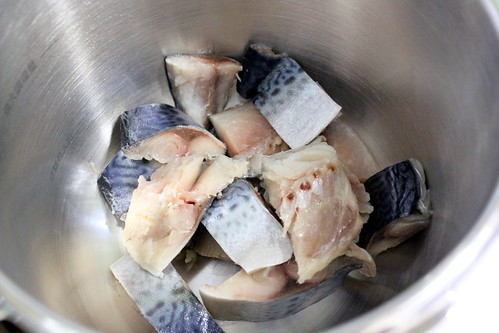
Cut them into pieces and put them in the cooker.
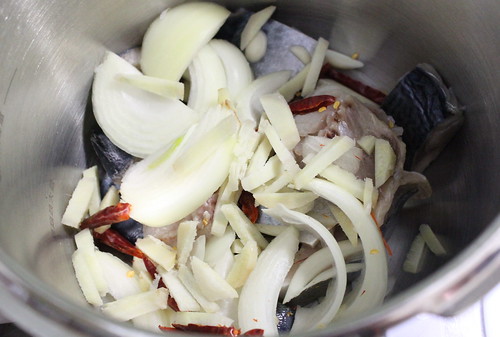
As usual, I used garlic, onion, ginger and chili. Only this time I didn`t saute them first, but I just chopped or sliced before throwing them in with the fish instead. I added sesame oil and olive oil thinking that doing so might help release the good smell components, which are fat soluble, from garlic, chillies, etc. I hope I`m doing this right, though.
I used more ginger this time to balance the fishiness.
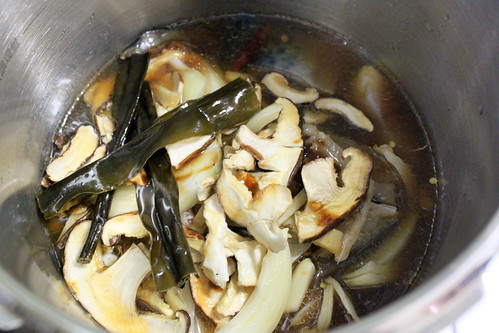
Add dried kombu seaweed and shiitake mushrooms. If you can, soak the dried mushrooms for at least 3 hours in water and pour it (water and mushrooms) in the pot. Just don`t use too much water during soaking, because we`re not making soup here.
Add soy sauce, oyster sauce, sugar, vinegar, salt, and pepper.
Turn on the heat and stir a bit. You can see here that I only added water enough to cover the ingredients.
Put the lid on, wait until the safety pin popped up, cook for 15 min, turn off heat, and wait until it`s safe to open the lid. Adjust the taste if you need to.
I wanted to thicken the sauce, so I cooked it for another 10 minutes without the lid. You can just serve it right away if you want.
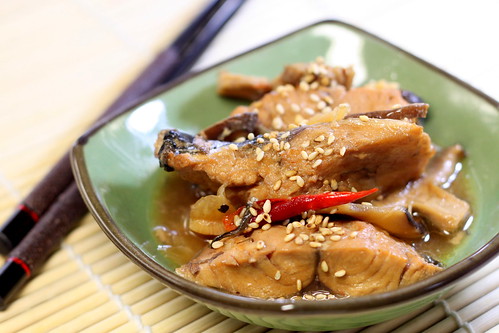
And the fish is done. Pretty simple, right? Yet this gives a very deep-flavored meaty fish with its whole bones completely tenderized.
With all my heart, I say, "Itadakimasu".
Ingredients:
Mackerel
Garlic
Onion
Ginger
Chilies
Sesame oil
Olive oil
Soy sauce
Oyster sauce
Vinegar
Sugar
Salt
Pepper
Sunday, April 3, 2011
Friday, March 25, 2011
Part 3. The hard times, gratefulness, and hopes
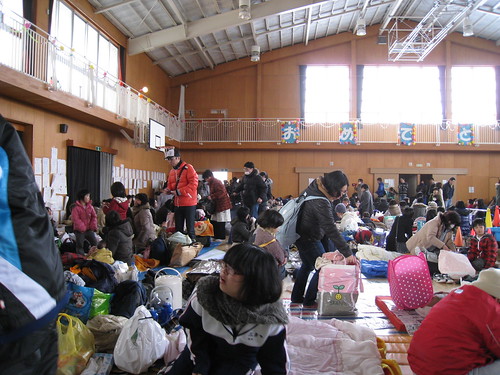
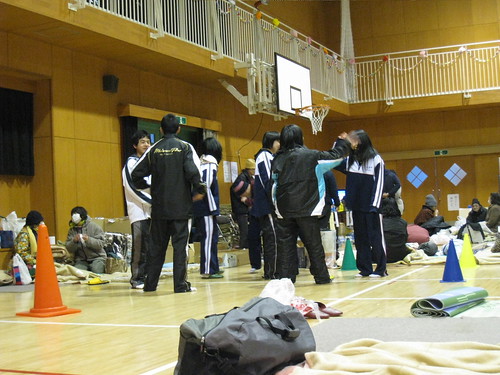
Bringing our bags and a blanket, we left the house and headed to the evacuation site at the school. It was a school gymnasium and quite big too (that night there were about 600 people in the room). There were volunteers were assembling two portable toilets outside when we arrived. We entered the room and together with other people who just arrived we registered our names and home address. There were mattresses arranged in 4 large groups with a kerosene heater placed in the center of each group. I really thought this was very impressive. It was just like 3 hours after the quake and volunteers were already working at the evacuation sites.
There were not many people that time and the room looked quite spacious, so it was easy to find a place for us. But more and more people came in leaving almost no space at all in the room. The mattresses were very limited in numbers, so everyone has to share in every possible way. The volunteers also distributed blankets and cartons to those who don`t get the mattresses.
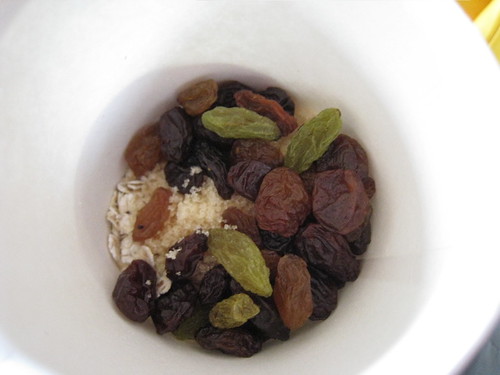
Dinner time. The volunteers told us that they have onigiri (Japanese rice balls) and water, but they wouldn`t be enough for everyone, so only children and the elderly were prioritized. The instruction for us during distribution was: Raise your hand if you really need food and water. To my astonishment, only few people raised their hands although I was sure everyone must have been hungry that night. I saw some people brought their own food like us, but many of them didn`t. Anyway, we ate our oatmeal and drank a little water to help swallowing it. Not a proper dinner, but much better than nothing.
It seemed like no one slept well that night. Phone connection, electricity, water, and gas were disrupted. The aftershock kept coming like in every 10-30 minutes that night and people looked very alarmed. There were many poor crying babies here and there with their exhausted parents. But to our surprise, we felt far safer staying with all of them that night.
Anyway, that morning we decided to take a walk outside (wearing our helmets) and we`re lucky enough to get some dried fruits from nearby shop.
It seemed like no one slept well that night. Phone connection, electricity, water, and gas were disrupted. The aftershock kept coming like in every 10-30 minutes that night and people looked very alarmed. There were many poor crying babies here and there with their exhausted parents. But to our surprise, we felt far safer staying with all of them that night.
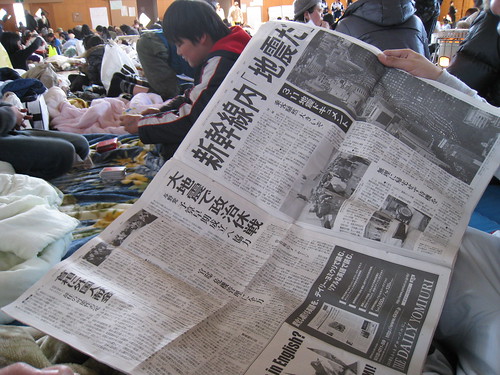
Then, the next morning some newspapers were delivered to our place. We finally knew what`s just happened the day before. The pictures of how tsunami has wiped out the whole coastal areas and news on thousands of people missing left us speechless. Knowing all these things, I was deeply grateful for having my husband, our house, food, healthiness, jobs, and many things else despite the disaster. Yet I felt terribly sorry for those who lost everything. The pictures of messiness in our house I showed you before are nothing, NOTHING compared to all those tragedies. I was so ungrateful for feeling bad about our house. It was just messy, that`s all.
Anyway, that morning we decided to take a walk outside (wearing our helmets) and we`re lucky enough to get some dried fruits from nearby shop.
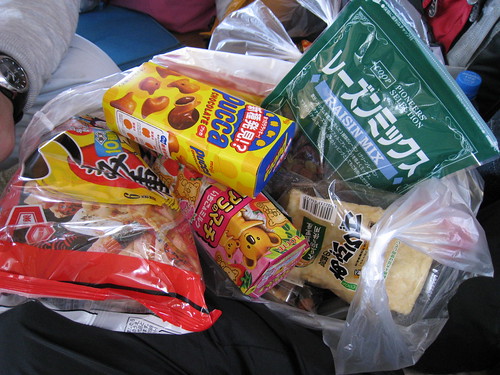
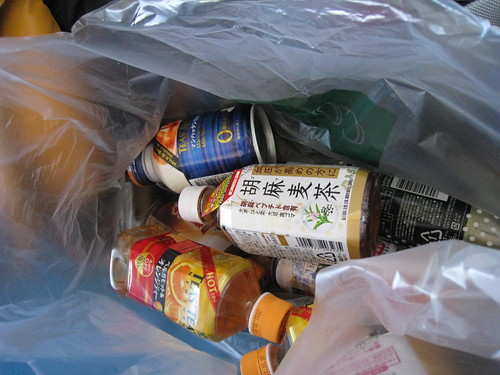
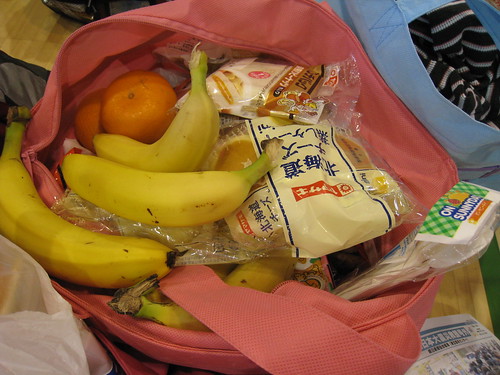
Day after day, there were more food and fruits for everyone in the site.
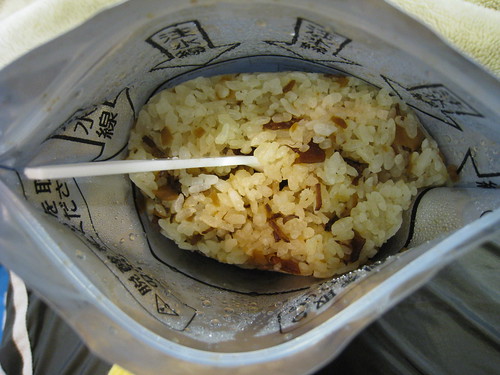
Sometimes there were emergency supplies sent from other prefectures/regions in Japan. One of them was instant rice with dried vegetables and chicken. Just pour hot water into the packet and the rice will be ready in 10 minutes. Warm food was a very special treat that time. Yum!
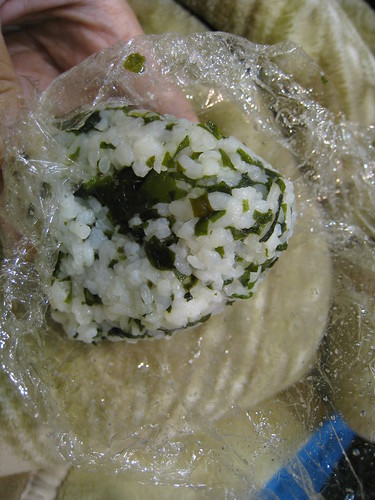
And on the 2nd day we got to eat the wakame onigiri (rice balls with wakame seaweed). The best onigiri we ever had. Probably because we were very hungry, but still, this is the best.
We stayed in the evacuation for 7 days and here are other things we thought impressive and interesting:
Newspapers were delivered everyday regardless the condition and we had a TV in the room on the next day. News are what we really need during that kind of time.
Many students (at our place, most were junior high) came to help as volunteers.
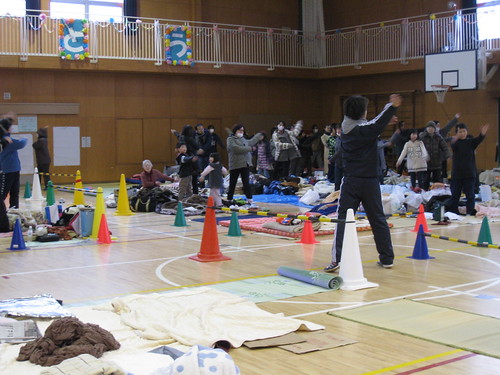
Every morning around 6:30, we had an exercise (here is called “rajio taiso”, or radio gymnastic exercise) following an instructor standing in the center of the gym with music played on the tape. It was a real fun and refreshing. Waking up at that kind of hour doing exercise wasn`t my thing at all, but I did enjoy it a lot!
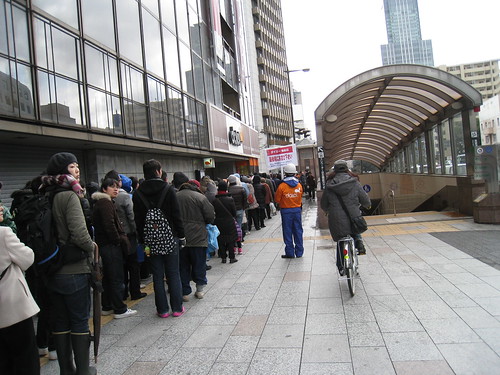
Lining up has always been a culture here. Even in this kind of emergency situation. When some shops were open, people still lined up.
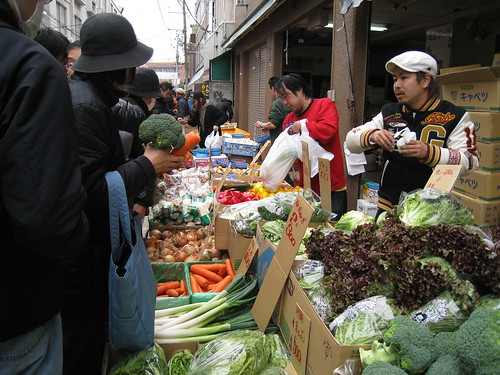
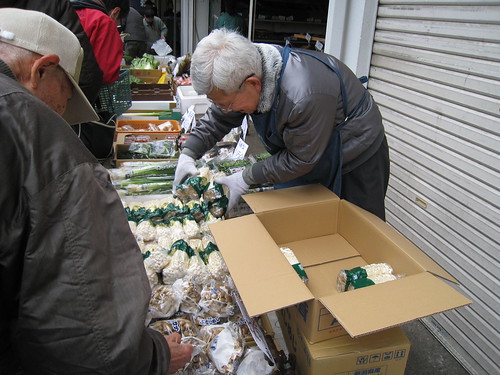
People here are trying hard to do what they can do regardless the difficulties. The fresh market in our was already open just a week after the big quake, although the amount and choices of food were limited. Looking at those food really made my day!
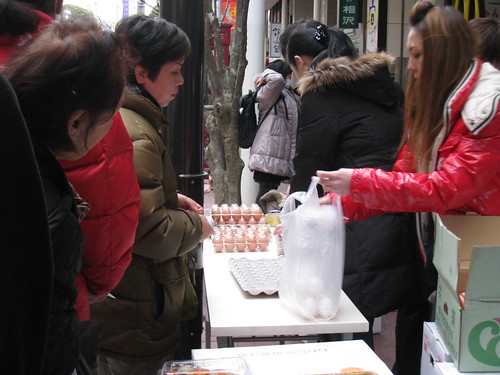
Not only in the market, the shopping area is turning into a temporary "fresh market" now with people selling many kinds of food, like fish, eggs, meat, vegetables, and even bentou.
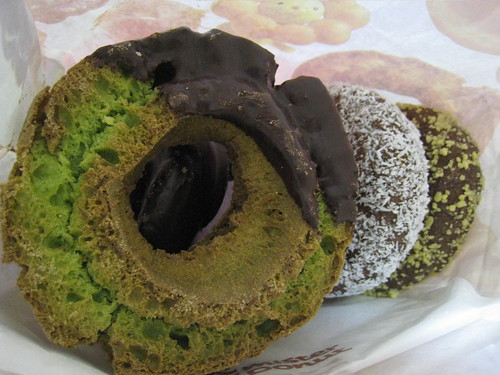
And I`d like to share these maccha (green tea) choco doughnuts with you. From us with love.
We`re very thankful to those of you who has been worried about us here, but really, we`re fine. It was indeed a difficult time, but we`re very glad with where we are and what we have now. The experience itself has enriched us with more new perspectives and gratefulness.
Thanks for bearing with our life stories and please keep supporting and encouraging the people. The daily aftershocks, the damaged areas with food shortage, thousands of missing people, and the battle with the nuclear issues are what Japan is facing now, but I hope the courage will stay strong, more and more help to come, and things will go uphill eventually.
Hope to be back soon with fun cooking stories in my coming posts!
Wednesday, March 23, 2011
Part 2. The mess and the (un)prepared bag
When my husband and I walked home from my lab (it`s only 15 minutes away by foot), I was stunned with what I saw outside the campus. The traffic lights not working due to the blackout, the sirens from ambulances and patrol cars screaming loudly, the road congested with cars and buses, snow falling heavily, and people crossing the road and rushing to and from every directions… It was somewhat chaotic. And it never happened before.
I held his arm very tightly throughout our way home while thinking hard what to do next. He told me that we had to stay in the evacuation site that night and some people were already there. Two reasons for us to evacuate: first, although our apartment building is fine, it was almost impossible to stay inside because the quake has turned our rooms into a big mess, and second, the aftershock quakes keeps coming (in fact, until today) and we knew it was much safer to stay together with many people in the evacuation site. Most of designated evacuation sites in Japan are school`s gymnasium and so was ours. We were very lucky that we have an evacuation site very near to our apartment and the building is new so the construction seems stronger than our building.
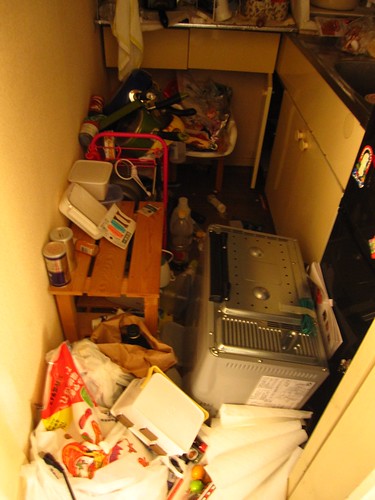
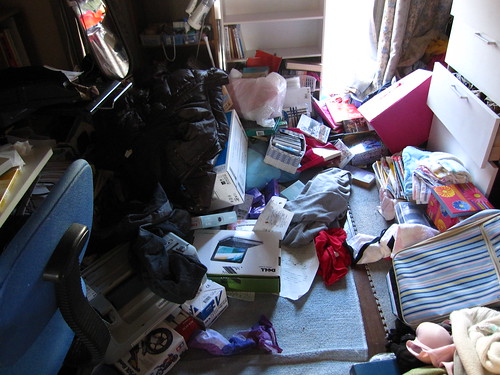
We finally got home and carefully entered the room. With our shoes on. This too never happened before. This is how it looked like in our rooms that day.
Broken pieces of glassware welcomed us on the entrance corridor (thus our shoes on). As I don`t have enough space in my kitchen, I placed some of our bowls and plates on a shelf near the entrance. Now I learned not to do it again. Ever.
In the kitchen, my oven fell off from top of my fridge. My heart sank looking at my dearly oven which was a wedding gift from my husband.
And this is in another room.
And our TV faced down on the floor. It`s a very old big heavy TV, really heavy.
But we didn`t want to stay any longer in the room. So I quickly grabbed my emergency bag, get a blanket, and packed some of his clothes. About the bag, I have prepared it in my room since the Sumatera`s tsunami in 2004 and my arrival in Japan where earthquakes are part of the casualties. I followed the survival manuals provided by the university, city hall, and international center and made some adjustment. Thing is, just months ago, because the drinking water and food inside the bag were either already or getting expired, I ate, drank, or threw them out. And I kept delaying to replace with new ones. So my emergency bag was a food-and-waterless bag. But I just brought it anyway, it was much better than nothing at all.
Another regret here was my husband didn`t have an emergency bag. He has never thought he would need it. Anyway, he quickly grabbed his important documents while I searched what food we had left in the kitchen. What I found? A bag of oatmeal and sugar. No, no complaint at all. These were still food and we needed them. And he happened to have one bottle of water and one bottle of Pocari Sweat in his bag. Good, now we had food and water.
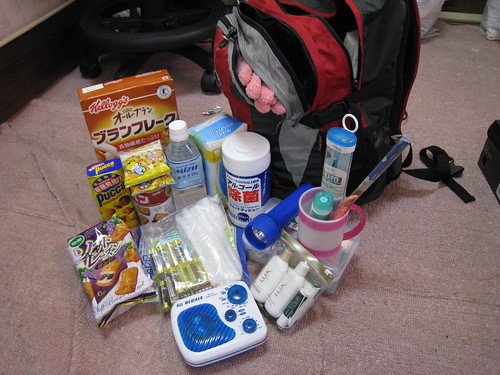
By the way, I just renewed some items for the bag recently and placed them on the floor so you can see them. Things on the floor are: corn flakes, biscuits, drinking water (there are more inside the bag), sanitary napkins, wet tissues (with alcohol for disinfectant), first aid kit and medicine box, toothbrush, soaps, plastic cup, flashlight, spare batteries, candles, matches, and portable radio.
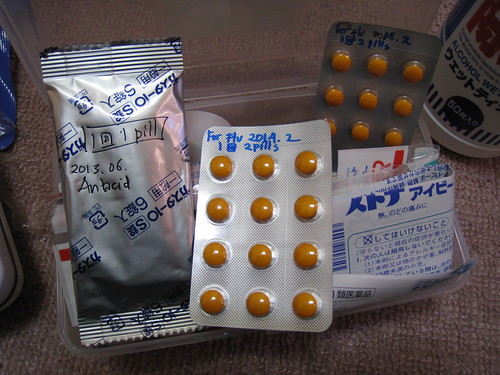
For the medicines, I keep them without the packages (boxes take too much space) but I wrote down what medicine it is, usage instruction, and expiry dates. I also keep the instruction sheets.
In the bag I have copies of important documents (passport, ID card, health insurance card, list of phone numbers of families and friends) kept in a waterproof folder, clothes, socks, and underwears, map, stationery, face mask, tissue papers, extra glasses (I`m practically blind without them), and plastic bags. The phone numbers can be useful when we don`t have our handphones with us or they`re out of power.
When you`re done preparing the bag, keep it in a place where it`s easy to get them when you`re in hurry. It depends on the house interior, but I put our bags (now he has his too) at the entrance corridor. Also, keeping a flashlight near your bed can be useful too if the quake hits at night and the the electricity is off.
I know I may sound like a paranoid (now I start to think I am), but if I`m given a chance to prepare myself, I certainly will.
Here I have a survival guidance (English-Japanese) provided by Tokyo government and so far I found this is the best one among all guidance I `ve found before. Although this guidance is intended for people who reside in Tokyo, hope this can be a useful source for you too. For the emergency supplies preparation, go to page 80. Everyone has their own necessities, so you might want to make some adjustment with the list.
Let me know at: aboxofkitchen@gmail.com if you have trouble with opening the file and I`ll send the file to you.
Subscribe to:
Posts (Atom)